By Emeka Alozie, Defense Innovation Unit Program Manager (contractor), Center for Strategic and International Studies (CSIS) Abshire-Inamori Fellow, and Publisher of The New Arsenal.
The views expressed in this article are those of the author and do not necessarily reflect the views of the Defense Innovation Unit, the Department of War, or the U.S. Government. The author writes in his personal capacity.
Here is a scene that plays out more often than it should. A founder walks into a room with something real: an actual working system, tested, iterated, proven against a real operational problem. The acquisition professional across the table is genuinely interested, and everyone in the room knows this capability matters. Then the process starts, the timeline emerges, and the founder does the math quietly and realizes the window they built for has already closed.
That gap, between what American founders are building and the speed at which the system can absorb it, is the civil-military fusion problem in its most concrete form. The technology is there, the capital has arrived, and what needs fixing is the structural seam between them.
The Weapon Is the Network
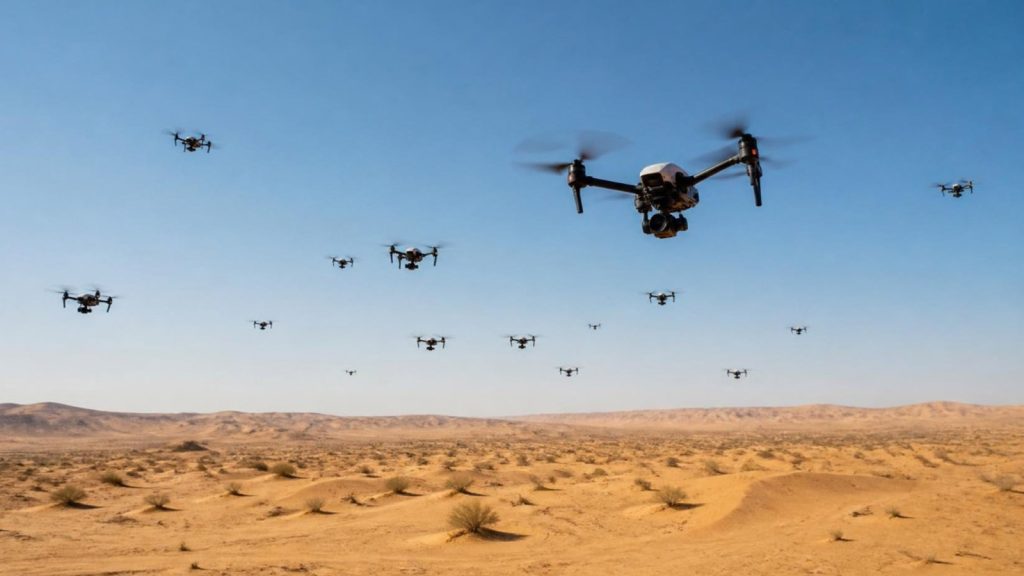
Russia launched more than 8,000 kamikaze drones [OR1] in a single month this past May. One Ukrainian manufacturer now produces 100,000 drones per month[OR2] , approaching America’s entire annual output. Ukraine did not get there by outspending anyone. It built a warfighting ecosystem where the distance between failure and fix collapsed to days. Drones failed in combat, operators modified them, and manufacturing changed within the week. New systems returned to the front almost immediately. Every failure became data and every data point accelerated the next version. Ukraine got there by iterating faster than the adversary could adapt. That is a fundamentally different theory of warfare, and it is now the standard against which every acquisition system in the West should be measured.
The old kill chain was linear: find, fix, track, target, engage, assess. A sequence at human speed, with a beginning and an end. The model replacing it is continuous. Sensing, processing, deciding, striking, adapting, at machine speed, without pause. Within the Council on Global Competition and Innovation’s (CGCI) Cybersecurity, Space, and Defense Technology sector, the dominant investment narrative has centered on platforms: things that fire, fly, or float. That framing is increasingly insufficient. Lattice, Anduril’s operating system for autonomous systems, is the connective architecture that makes a fleet of heterogeneous autonomous assets behave as a single coordinated force. The drone is downstream of it. Software-defined command architecture is where durable investment value accumulates in this category, and it is the layer most Western procurement systems are still not designed to buy.
What Civil-Military Fusion Actually Means
China’s industrial and military base operate as a single system, under unified standards, eliminating the boundary between civilian research and military application so that breakthroughs in AI, advanced manufacturing, and autonomous systems flow directly into military capability. Replicating that model is neither possible nor desirable. The competitive pressure, distributed risk-taking, and iteration speed that American markets produce are precisely what makes American technology worth having. The more useful observation is that the United States already possesses something China is trying to construct artificially: a commercial technology economy that is dual-use by nature. The challenge is coordination, not fusion.
Autonomous systems are already running ports, warehouses, and agricultural operations. AI manages logistics networks and energy grids. Spectrum management tools built for commercial telecom apply directly to contested electromagnetic environments. The commercial sector is building what defense needs, often faster and with tighter feedback loops than military acquisition can generate internally. A robotics company whose stack works in a warehouse can adapt it for Marines with the right compliance and mission layer. A maritime autonomy company solving offshore energy logistics is solving the same sensor fusion problems the Navy faces. The technology does not need to be rebuilt. The contracting vehicles, security frameworks, and capital structures that allow defense to buy at commercial speed do.
The National Defense Industrial Strategy recognizes this. DIU’s mandate is to transition commercial technology into military use at speed against critical capability gaps. The policy direction is right, but the execution gap is where the strategic risk lives. Every cycle the commercial sector completes that defense cannot absorb is a cycle the adversary can study and field faster.
The IDIQ Model and the Capital Signal
In May 2026, the Dutch Ministry of Defence signed a counter-drone contract with Anduril. By early June, the system was operational: signature to fielded capability in under a month. The same class of system, acquired through traditional channels, takes 18 to 36 months. That is not an incremental improvement but a different category of procurement entirely.
The mechanism is the Indefinite Delivery, Indefinite Quantity contract, the IDIQ, which pre-qualifies a vendor and lets the government issue task orders without re-running the full acquisition process. In March 2026, the U.S. Army awarded Anduril an IDIQ valued at up to $20 billion for AI-enabled systems, folding more than 120 separate contracts into a single vehicle. For decades, the unit of defense procurement was the platform. The IDIQ moves it up a level to the relationship. The government buys ongoing access to a company’s capability to build and adapt, then directs it against whatever threat is in front of it this quarter. That is how software is bought. The fact that the Pentagon is now applying it to non-traditional contractors signals a shift from experiment to doctrine. The Dutch deal is the first evidence this model is traveling to allied militaries.
The IDIQ is not an Anduril story but a structural opening. Any company that can demonstrate capability and meet the qualification threshold can compete for task orders under an existing vehicle without enduring a fresh multi-year procurement cycle. For the defense technology founder, that changes the commercial calculus entirely. The path from proven capability to paying customer compresses from years to months. For investors, it changes the risk profile. A company sitting on a validated IDIQ relationship is not waiting for the government to discover it. The access is already established. The question is execution.
The United States also needs to get better at turning military pain points into investable commercial categories, because that translation is what makes the broader market legible to capital. Contested logistics is not a defense niche but the autonomous supply chain market. Spectrum congestion is less a Pentagon problem than the infrastructure layer underneath smart cities, factories, and next-generation telecom. Counter-drone defense, meanwhile, is already the security architecture that stadiums, airports, and power plants will need. When military demand is framed as the first and most urgent customer in a much larger market, it stops being a constraint on investment and starts being a catalyst. Companies like Saronic and ShieldAI, whose Hivemind autonomy stack is platform agnostic, [OR3] are building interoperable autonomous architectures because the commercial opportunity and the strategic requirement are pointing in the same direction. They are not waiting for policy to validate the market. The market is already there.
When the IDIQ vehicle, the commercial translation, and the capital language are operating in alignment, the result is something the West has rarely achieved: a defense posture that moves at the tempo of the threat rather than the tempo of the budget cycle. Acquisitions compress, capability compounds, and allies can plug into shared architectures rather than procuring in parallel. CGCI’s methodology framework exists to make these distinctions legible to the sovereign wealth funds, pension capital, and venture funds that need a common language to act on defense technology as a coherent investment category. That standardization is not administrative housekeeping so much as what turns a collection of promising companies into a coordinated industrial response.
The founder who walked into that room had built something real, and there was no reason procurement delay should have made it obsolete before it ever reached the field. When the contracting model matches the operational tempo, the story ends differently, and that is no longer theoretical: the Dutch Ministry showed it can happen, and the Army’s $20 billion IDIQ showed it can happen at scale. What remains is whether enough founders, investors, and acquisition professionals act on that proof before the next capability stalls out in the same queue.