Five months of war have driven the U.S. strategic petroleum reserve to a 43-year low—while China has spent the past decade building its energy buffer.
By Maisoon H. Kafafy, Senior Advisor, Atlantic Council
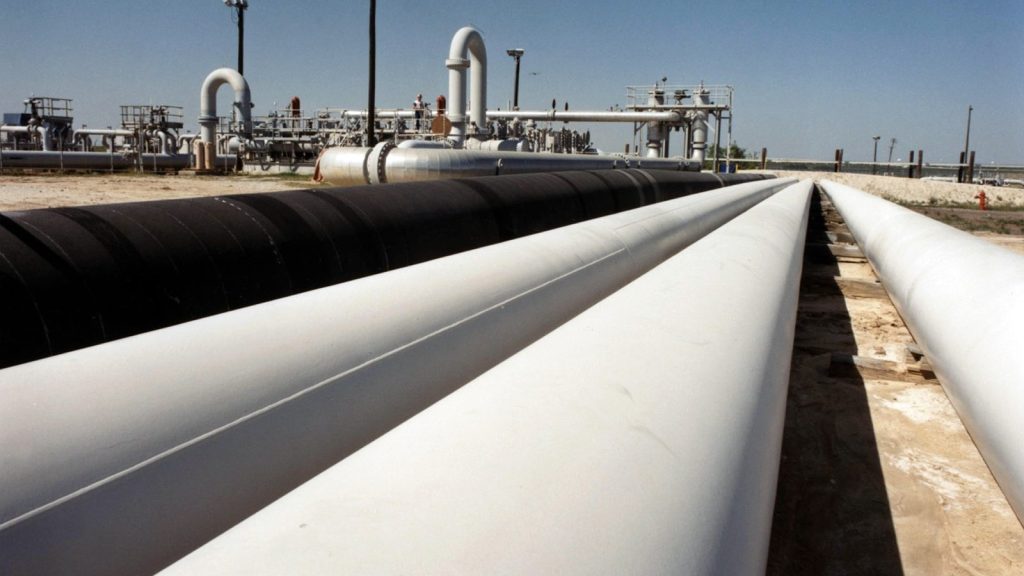
The U.S. Strategic Petroleum Reserve now holds around 307 million barrels, less than at any point since the spring of 1983 – when the reserve was still filling. The caverns beneath the Gulf Coast were new then, and every tanker that unloaded added to a capability the United States was building for the first time. Five months of war with Iran have reversed the direction of that flow, drawing the reserve down to a 43-year-low in a country that has meanwhile become the largest oil producer the world has ever known.
Since the war began, attention has fixed on the oil stranded behind the Strait of Hormuz, and almost none has gone to the oil drained on this side of it, or to what that drawdown says about the American energy position. Through the shale years, Washington treated abundance as security itself: a country pumping over 13 million barrels a day, the thinking went, has little need to store them. That reasoning runs together two different kinds of strength. Production determines what a country can sell, while cover, meaning the volume it holds and the time that volume buys, determines what it can refuse and how long it can hold a position while others decide whether to test it.
What the War Took
The war opened on February 28, and within a week crude and product moving through the Strait of Hormuz had collapsed to under ten percent of normal volumes, pulling at least 10 million barrels a day of Gulf supply off the market. On March 11, the 32 members of the International Energy Agency agreed to release 400 million barrels from emergency stocks, the largest coordinated action in the agency’s 50-year history. Washington pledged 172 million of it, from a reserve that held roughly 415 million barrels the day the pledge was made.
Some 107 million barrels have left the caverns since, and in one week in mid-May the outflow neared 10 million barrels.
By any operational measure the response succeeded: prices came off their peaks, refineries kept running, and fuel stayed on the shelf, which is about as much as anyone could reasonably ask of American crisis machinery. The performance also consumed a quarter of the nation’s stored oil to buy five months of calm, and much of the commentary since has treated that calm as vindication while passing over what it cost.
The Cushion Nobody Built
The reserve was only one of the cushions the system landed on; the other was an accident. In the two years before the war, the world produced more oil than it consumed, and the surplus went into tanks, leaving over 8 billion barrels sitting in storage worldwide when the fighting started. Most of that volume can never be touched, since it is the working fill of pipelines, refineries and tankers, the oil the system needs simply to run, which is why J.P. Morgan put the share that could actually be drawn at about 800 million barrels. A third of it was gone by late April.
Nobody designed that cushion and no government paid to build it; it existed because producers and traders were holding barrels they could not sell, and it happened to be sitting there when the war arrived. The IEA was candid about the limits of its own action: in its monthly oil market report, published days after the 400-million-barrel release was announced, the agency described the measure as a stopgap, a bridge to the resumption of normal shipping through Hormuz rather than a substitute for it. Much of this spring’s shock absorption came from an accident of the market, and accidents do not repeat on schedule.
Opposite Trades
On June 26, the Government Accountability Office (GAO), the audit arm of Congress, reported that age has caught up with the network of caverns, wells and pumps along the Gulf Coast. The reserve can now pump oil out at about 60 percent of the speed it was built to deliver, and take oil back in at just over half that, while a repair program approved in 2016 runs years behind schedule and the government has not updated its long-term plan for the reserve since that same year. GAO’s summary was that the reserve’s ability to perform its mission is at risk.
The level tells a similar story of accumulated decisions. Over the past decade the reserve has been drawn on more heavily than in all its previous history combined, for genuine emergencies, including a 180-million-barrel release after Russia invaded Ukraine, but also for price relief, and for roughly 140 million barrels of congressionally authorized sales between 2017 and 2023 that funded other budget priorities. Each release was lawful and each had its reasons, but together they carried the reserve into this war at 415 million barrels, well under two-thirds of its capacity, and the war has taken another hundred million since. Federal law begins restrictinghow the reserve can be used once it falls below 252.4 million barrels, a line that at recent rates is months away.
China spent the same decade moving in the opposite direction: the U.S. Energy Information Administration estimates Beijing added an average of 1.1 million barrels a day to its strategic inventories through 2025, reaching roughly 1.4 billion barrels by December, with buying continuing into 2026. China does not publish reserve figures, so outside estimates are built from trade and refining data and carry a margin of error. The construction is easier to verify, with media outlets tracking Sinopec and CNOOC, two of China’s state-owned energy majors, adding at least 169 million barrels of new storage across eleven sites.
Washington Rents what Beijing Owns
Beijing holds its buffer outright. China’s Energy Law, in force since January 2025, combines state stockpiles with mandated enterprise reserves, distributing the cost of holding oil by statute rather than relitigating it every budget cycle. Washington, which has no budget line for cover at all, improvised. When it needed to move oil this spring there was no money set aside to replace what it released, because the account that funds reserve purchases was largely depleted years ago, so rather than selling the oil the Department of Energy lent it. Trading companies took delivery of crude from the reserve at the height of the crisis and signed contracts to return it later with more oil added on top, between 18 and 28 percent more depending on the contract, with deliveries due between late 2026 and 2028. More than 133 million barrels have moved on those terms since mid-March.
On its own terms the arrangement works, since the reserve ends up with more oil than it lent without Congress spending a dollar. What it says about the position underneath is less flattering. In the middle of a war, the United States was borrowing back its own strategic reserve at interest, because owning cover outright had never been funded, and the returned barrels will arrive at a reserve that, by GAO’s measure, can absorb them at barely half its design rate. China owns its buffer while America rents its own back, a difference that reads as a footnote in one crisis but compounds across a decade of competition, and the premium is what the market charges to cover the gap.
Pricing the Buffer
For investors in strategic commodities, the past five months put a price on something that never had one. Storage has long been the quiet end of the energy business, a world of tank farms, marine terminals, salt caverns and the financing that carries inventory, where the returns are steady, fee-based, and rarely the headline. The crisis surfaced a second customer for that capacity in governments, which will pay double-digit premiums for held volume when the moment arrives and whose need for cover persists long after their attention has moved on.
The template for capturing that demand already exists in critical minerals, where recent federal agreements pair a price floor with long-term offtake and an equity stake. Together those components turn a stockpile into a bankable position, because the floor caps the downside while the offtake guarantees an exit and the equity keeps the sponsor aligned. Applied to crude, the same structure produces availability payments for tankage and cavern capacity held against a defined emergency, which for an investor means contracted cash flow in place of commodity exposure, sovereign counterparties, and duration measured in decades.
Today that demand is met the expensive way, through emergency solicitations run mid-crisis at whatever premium the moment commands. The alternative is a standing arrangement of long-term contracts under which private capital builds and holds strategic volume while the government pays a fixed annual fee for guaranteed access, much as utilities already pay for generating capacity they may never call on. Both sides come out ahead, with the state getting its cover at a fraction of crisis pricing and the investor getting contracted multi-year revenue, and the firms that structure the first of those contracts will set the terms for a market that, as of this spring, visibly exists.
What Decides the Next One?
The Council on Global Competition and Innovation’s (CGCI) 2025 report, From Strategy to Execution, closed its energy chapter on an open question: whether capacity would finally be priced as insurance against wartime shocks, or carried indefinitely as a peacetime cost item. The report warned that benchmarking to peacetime averages locks in cheap, brittle systems at precisely the moment adversaries move to weaponize supply.
Over the past five months the system held, but it held on a glut nobody planned, drawn through a reserve now at a forty-three-year low, with refill machinery running at half its design rate and more than 400 million barrels of empty capacity that no budget line anywhere proposes to fill.
The weakness on display is the older confusion between what a nation can pump and what it can withstand, one that record production has done nothing to resolve. Production carries a country through the years when nothing happens, and cover carries it through the weeks when everything does. The buffer is the strategy.
About the Author
Maisoon H. Kafafy is a Senior Advisor to the Atlantic Council Middle East Programs, where her work focuses on geoeconomics, security, and technology cooperation.