By Karl Muth, CGCI NSRA Council Member, AI Researcher, and Interdisciplinary Professor
Introduction: The Changing Apparatus of Homeland Security
As the United States solemnly observes the 25th anniversary of the September 11 attacks, the domestic threat matrix has never been more complex.
It’s become clear the proliferation of potential threats of domestic terrorism, sophisticated sabotage, cybercrime, and master-planned fraud requires a security apparatus capable of adapting faster than state actors and non-state adversaries. Concurrently, a fundamental shift toward the privatization of security is reshaping how the Homeland is defended.
Driven by initiatives like the Department of Government Efficiency (DOGE) and a broader, urgent mandate to trim federal bloat, the traditional boundaries between government law enforcement, military garrisoning, and private security are blurring.
Today, global megacontractors such as the UK’s G4S (one of the world’s largest private employers with a workforce exceeding 750,000) continue to absorb the essential “first fence” garrison and patrol duties. These are the unarmed folks photographing your license plate with an iPad when you pass the first fence, the person with a LTL weapon or service sidearm keeping track of containers leaving a port, and the night watchman scaring off opportunistic trespassers and would-be construction site thieves.
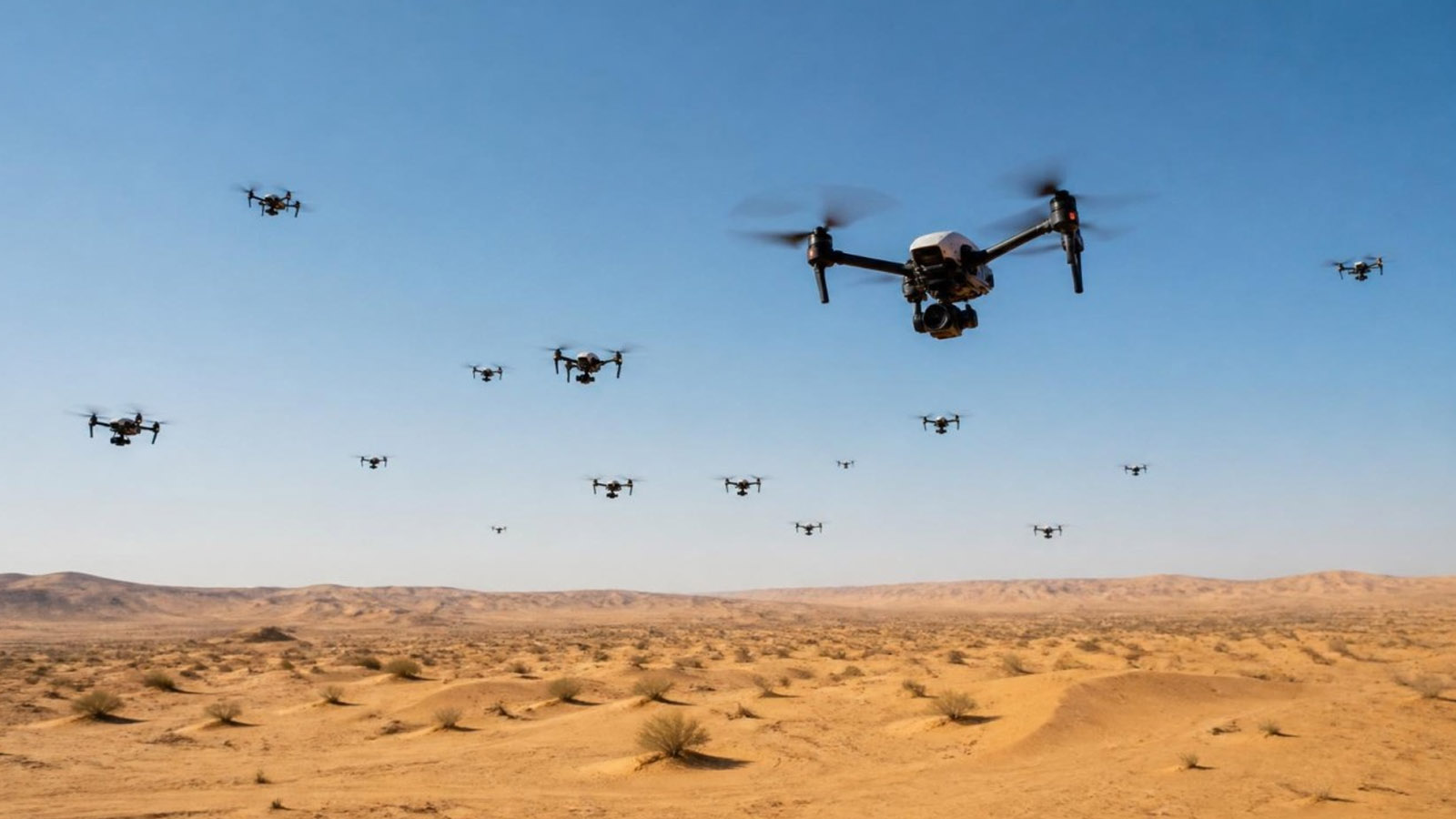
However, the private sector’s role is rapidly expanding beyond simple perimeter duty into highly specialized, niche capabilities. Modern private security operations involve complex, multi-layered deployments: sensor fusion, semi-autonomous drone operations, real-time post-incident analysis, and the deployment of both lethal and advanced less-than-lethal weapon systems. Securing the nation’s ports and facilities will require more than a nightclub bouncer checking IDs.
As the operational burden shifts to private contractors, American technology firms are innovating at an unprecedented pace to provide the necessary overmatch.
Private security contractors now intercept threats using advanced machine learning and multi-spectrum surveillance. The critical vulnerability lies not in the technology, but in the legal architecture. When a private contractor neutralizes a threat, the legal and financial next steps depend upon how that threat is classified. In the complex world of liability and excess and surplus lines (E&S) insurance, pricing the risk of catastrophe requires navigating conflicting federal definitions of what constitutes “terrorism.”
This is further complicated by the Administration at times using differing definitions of “terrorism” and “terrorist” or, worse, often using these words with no definition at all.
The Definitional Crisis: What is Terrorism?
While a variety of American technological innovations now provide the means to detect and neutralize threats, the legal framework governing these events remains dangerously fragmented and confusing.
When a private security firm intercepts an armed intruder at a power plant or a school, the ensuing legal and financial ramifications orbit entirely around how the attacker’s actions are legally classified—on the same fact pattern, it is not unusual for a legal onlooker to ask: is this person a trespasser, a burglar, or a terrorist?
The United States currently operates under conflicting statutory definitions of terrorism. This creates a “motive gap” that threatens the stability of the private security and insurance markets. At the core of this definitional crisis is the question of mens rea, or the state of mind required to classify an act as terrorism.
Terrorism law in the United States is split between Title 18, which hinges on proving political motive and often misses modern mass violence, and Title 8, which focuses on dangerous acts and better captures nihilistic, non-political attacks. That gap matters because private security and insurance must underwrite and equip against the full spectrum of real-world threats, not just those that fit a narrow, motive-based definition.
Pricing the Risk: Liability in the Private Security Market
As government agencies cede operational territory to private megacontractors, the assumption of risk shifts to the private sector. Nearly all security contractors are required to be “licensed and insured” in order to land a job, but what does this mean in the modern context? Are the typical $2M or $5M excess limits adequate?
If a contractor’s drone swarm misidentifies a target, or a fixed-wing UAV collides with a mountain ridge transmission power line in a rural area (this can easily be a $2M repair), or a guard fails to prevent a mass casualty event, the resulting tort litigation will be monumental. To survive, these firms rely heavily on the excess and surplus lines (E&S) insurance market, which acts as a vital blow-off valve to underwrite rare but high-magnitude risks.
Any ambiguity in an insurance coverage document is inherently dangerous to an insurance firm, its reserve capitalization, and its shareholders. Because private security firms and their insurers rely, in turn, on government definitions of terms like terrorism, there must be an effort to coordinate and clarify these words’ meanings so they are useful to operators, prosecutors, insurers, and others.
The Danger of Ambiguous Exclusions
Insurers protect their reserve capitalization through absolute categorical exclusions, but it is a fundamental principle that “an insurer cannot escape its basic duty to insure by means of an exclusionary clause that is unclear.” In order to effectively exclude coverage, the clause must be “conspicuous, plain and clear.” If an E&S policy utilizes the Title 18 definition of terrorism in its exclusions, the insurer (and potentially the private security firm relying on that coverage) is left exposed.
Strategic Contractual Architecture
For the private security apparatus to scale effectively and sustainably alongside DOGE-era federal reductions, legal and underwriting precision is paramount. To adequately price risk and avoid devastating liability, general counsels and E&S underwriters must look beyond colloquial definitions and standard boilerplate.
The adoption of Title 8’s broader, action-based definition (or the disjunctive integration of both Title 8 and Title 18 into policy exclusions and liability waivers) provides the most robust shield. By stripping away the burdensome requirement to prove political intent, and focusing instead on the empirical deployment of dangerous devices, private firms and their underwriters can establish a predictable, clear standard for liability.
American Technological Overmatch: Protecting the Homeland
To align with a posture of robust security and defense, American tech investments are heavily focused on preemptive, high-acuity threat detection. The modernization of the private security space relies on replacing headcount with intelligent, scalable systems; this is a mandate that aligns with the Council on Global Competition and Innovation’s mission to accelerate capital into critical, defense-aligned technology sectors.
Hypersonics and Space Technology: Seeing from Exotic Viewpoints
Sensors mounted on ground, aerial, and orbital vehicles are more related than ever before; while sensor loadouts are customized and optimized for each application, today’s sensor fusion and signal deciphering technologies can understand a flood of information that would have been overwhelming before. Using technologies developed for bleeding edge aerospace and low-orbit systems, these sensors allow monitoring from perspectives and positions that were inaccessible or financially impossible not long ago.
The traditional reliance on localized CCTV and static cameras is being supplanted by persistent, wide-area surveillance. American aerospace and defense tech firms are deploying orbital and fixed-wing look-down imagery paired with advanced machine vision. The rapid commercialization of these technologies is staggering: where sub-decimeter resolution was restricted to state-of-the-art military applications a decade ago, contemporary mid-grade commercial systems can now reliably execute high-altitude license plate recognition.
- Persistent Threat Recognition: Using convolutional neural networks, these systems can identify anomalous behavior patterns across vast geographic areas. This includes spotting similar suspicious activity even if those engaged in the activity are not (or not yet) coordinated or in communication.
- Beyond-Visual-Spectrum Surveillance: By integrating synthetic aperture radar (SAR) and infrared spectrums, contractors can maintain visibility through cloud cover, foliage, and darkness, eliminating the traditional operational pauses exploited by saboteurs.
- Loiter and Movement Analysis: Algorithms calculating dwell time and spatial relationships can automatically flag vehicles or individuals exhibiting pre-attack reconnaissance behaviors around critical infrastructure, seamlessly passing this data to ground-based private security or federal authorities.
Who to watch? A leader in persistent threat recognition through passive RF sensing is Hidden Level, whose systems provide wide-area, real-time airspace awareness that flags anomalous reconnaissance behaviors around critical infrastructure.
Who else? On the ground, VOLT AI gathers terrestrial intel using machine vision and interprets real-time video intelligence by fusing feeds across hundreds of cameras to flag pre-attack reconnaissance behaviors and enable immediate ground response.
Who else? Complementing traditional camera approaches like VOLT AI’s, LOCH Technologies delivers next-generation wireless airspace defense, using AI to detect and classify RF-emitting threats in real time across ports, rail yards, power stations, and other sensitive facilities.
Artificial Intelligence and Quantum Computing
Artificial intelligence in the context of detecting, identifying, and intercepting terrorists involves a mixture of pattern recognition systems, whether tracking people, cargo, or financial transactions. The latter is a particularly interesting area and while the private sector uses similar models for credit card fraud alerts and KYC checks, those fighting antiterrorism use similar algorithms to understand these serious threats.
Terrorism and organized sabotage require capital; thankfully, even the bad guys usually don’t work for free. Tracking the domestic and international movement of funds has historically been a reactive, labor-intensive forensic process. Today, machine learning models are deployed directly onto financial flows and payment rails to spot terror networks before an attack materializes.
- Behavioral Financial Modeling: AI models analyze millions of micro-transactions, identifying the distinct financial signatures of terror cell capitalization—often characterized by specific ratios of prepaid card purchases, decentralized cryptocurrency tumbling, and structured wire transfers.
- Fraud-to-Terror Pipelines:Because domestic terror groups frequently fund operations through cybercrime and identity fraud, predictive models are now mapping the nexus between localized fraud rings and broader ideological violence, allowing private financial security contractors to freeze assets algorithmically.
Who to watch? On the payment rails, TRM Labs deploys machine learning models that map the nexus between localized fraud rings and ideological violence, allowing private financial security contractors to interrogate the provenance of suspicious assets algorithmically before attacks materialize.
Who else? ZenLedger began a decade ago as a platform for early crypto investors to sort out their taxes; today, they work with the government and law enforcement (including the IRS) to build and deploy AI tools to identify suspicious blockchain activity and allow examination of the data in its BATS environment.
Microelectronics and Semiconductors
Microelectronics enable sensor technologies and detection systems that were science fiction only a decade or two ago.
The threat of a domestic attack utilizing radiological material (such as a dirty bomb or a localized contamination event) remains a paramount concern. Legal and technical literature on transnational hazards demonstrates a single improperly discarded MRI machine or a dozen salvaged legacy industrial smoke detectors can provide the illicit materials needed for a viable nuclear contamination attack.
The private sector is bridging the gap in domestic movement tracking through distributed sensor networks.
- Passive Distributed Sensors: Private contractors managing critical logistics hubs (ports, rail yards, and highway weigh stations) are embedding high-acuity, solid-state radiological detectors into standard operational chokepoints.
- Isotope Fingerprinting:Modern AI-driven detectors do not merely alert to the presence of radiation; they instantly analyze the energy spectrum to differentiate between harmless medical isotopes, naturally occurring radioactive materials, and weapons-grade anomalies, drastically reducing false positives and enabling immediate, targeted interdiction.
Who to watch? A leader in new approaches to radiological threat detection is Physical Sciences Inc. (PSI), whose high-acuity solid-state detectors embedded in high-traffic logistics hubs instantly differentiate weapons-grade material from benign sources.
Who else? Private contractors managing ports and logistics hubs use technologies like those from Arktis Radiation Detectorsfor high-acuity radiological sensors that embed seamlessly into operational chokepoints and provide instant isotope fingerprinting.
Conclusion
The future of American homeland security lies at the intersection of unprecedented technological capability and precise legal taxonomy.
As the federal government leans heavily on private enterprise to deliver specialized security solutions, contractors will continue to deploy orbital machine vision, sophisticated financial algorithms, and high-acuity radiological sensors to detect and dismantle threats before they materialize.
However, technological overmatch is insufficient if the legal and financial frameworks supporting it collapse upon contact with the enemy. The ongoing privatization of defense requires an equally sophisticated approach to risk allocation. By understanding the “motive gap” between competing federal statutes, and strategically structuring liability around the empirical actions of adversaries rather than their nebulous ideologies, the private security sector can sustainably protect both its balance sheets and the security of the nation.
For those operating across the defense, technology, and risk-transfer markets, ensuring this alignment is not just a matter of doctrinal neatness; it is a critical prerequisite for mission success.
For capital markets, this definitional shift presents a massive investible gap in the risk-transfer stack. As technological progress and scope of these defensive technologies scales, the insurance capacity to underwrite its deployment is lagging.
Alternative capital, private credit, and insurtech venture funds have a rare opportunity to build out insurance-linked securities and catastrophe bonds tailored specifically for macroscale domestic security events.
Investors who participate directly or indirectly in efforts to address this non-TRIA-dependent risk (and back the hardware and software companies mitigating it across the Council on Global Competition and Innovation – CGCI’s core priority sectors) may enjoy an advantage in a part of the risk market that has not seen real innovation in a generation.
About the Author
Karl T. Muth is a Lecturer at the Northwestern University Pritzker School of Law and, by separate appointment, also teaches at Northwestern University across other disciplines. Outside of his work on market regulation, his primary focus is machine learning and AI research.
This piece draws thematically from Muth’s work with Alice Locatelli (of the Society of Actuaries) in the piece What is Terrorism? in The Journal of Air Law & Commerce (forthcoming 2026). Disclosure: Muth is an investor in ZenLedger, which is mentioned in this article.