By David Stuckenberg, Ph.D., MPS, Lt. Col. USAF, CGCI Council Member, Program Director PROJECT TRANSCENDENCE, President and COO Genesis Systems® (USA) – Water Your Way
The opinions expressed are those of the author alone and do not represent the official views of the U.S. Government or Department of the Air Force.
My family was once held hostage by armed gunmen. There was no chance to whisper a plan; speaking might have gotten us killed. Instead, we held an entire conversation with our eyes—reassuring one another, choosing a moment. When pedestrians unknowingly wandered into the scene, their presence created a brief distraction. We moved as one, escaped, and lived.
Survival is rarely accidental. It is the product of preparation, perception, and the will to act.
All of us live with quiet contingency plans. We buy insurance, keep our phones charged, and buckle our seatbelts. Deep down, we know emergencies happen. If survival is not at the forefront of our minds, it is never far from the back.
Ben Sherwood’s The Survivor’s Club cites research indicating that airline passengers who read the seat-back safety card are about 35% more likely to survive a survivable crash. They exhibit higher recall, less panic, and faster reaction times. Sherwood suggests that in crises, people tend to fall into three groups: fatalities (those killed due to trauma), victims (those who fail to act), and survivors—the ones who refuse to give up until they are safe.
The difference between victims and survivors often comes down to a single variable: action.
Today, the global West resembles less a confident system of alliances and governments and more a cabin full of passengers exchanging uneasy—and perhaps knowing—glances. We sense the rules-based international order is destabilizing. Political, economic, technological, cultural, and climatic stresses are converging and compounding in ways we understand are increasingly unpredictable. But what are we doing about it?
For more than two decades as a military planner, strategist, and scientist, my mandate has been to discover and mitigate strategic blind spots. Not as a psychic, but as a pattern and systems analyst: Where will trends collide? Where can systems fail? Where are our beliefs misplaced? What cognitive and institutional biases prevent truth from penetrating our thinking and our worldviews? What will our enemies do?
The Fukushima disaster was caused by a blind spot. The Daiichi nuclear plant was designed to withstand any statistically “probable” emergency. Then a “low-probability” tsunami exceeded the models. Floodwaters destroyed backup generators, submerged DC batteries, and severed outside power. Frantic workers scrounged car batteries from wrecked vehicles to try to power vital cooling systems. After a few hours, latent reactor and spent pool heat overwhelmed containment, and the resultant explosive releases of radiation could be detected as far away as New England. A beyond-design-basis event—a scenario no one had fully planned or modeled for—became a strategic disaster.
I have watched similar patterns unfold in dozens of areas involving technology and strategy. And now, the fundamental basics humans rely on in modern society (food, water, sanitation, telecommunications, energy, etc.) have come into view. A few examples to illustrate.
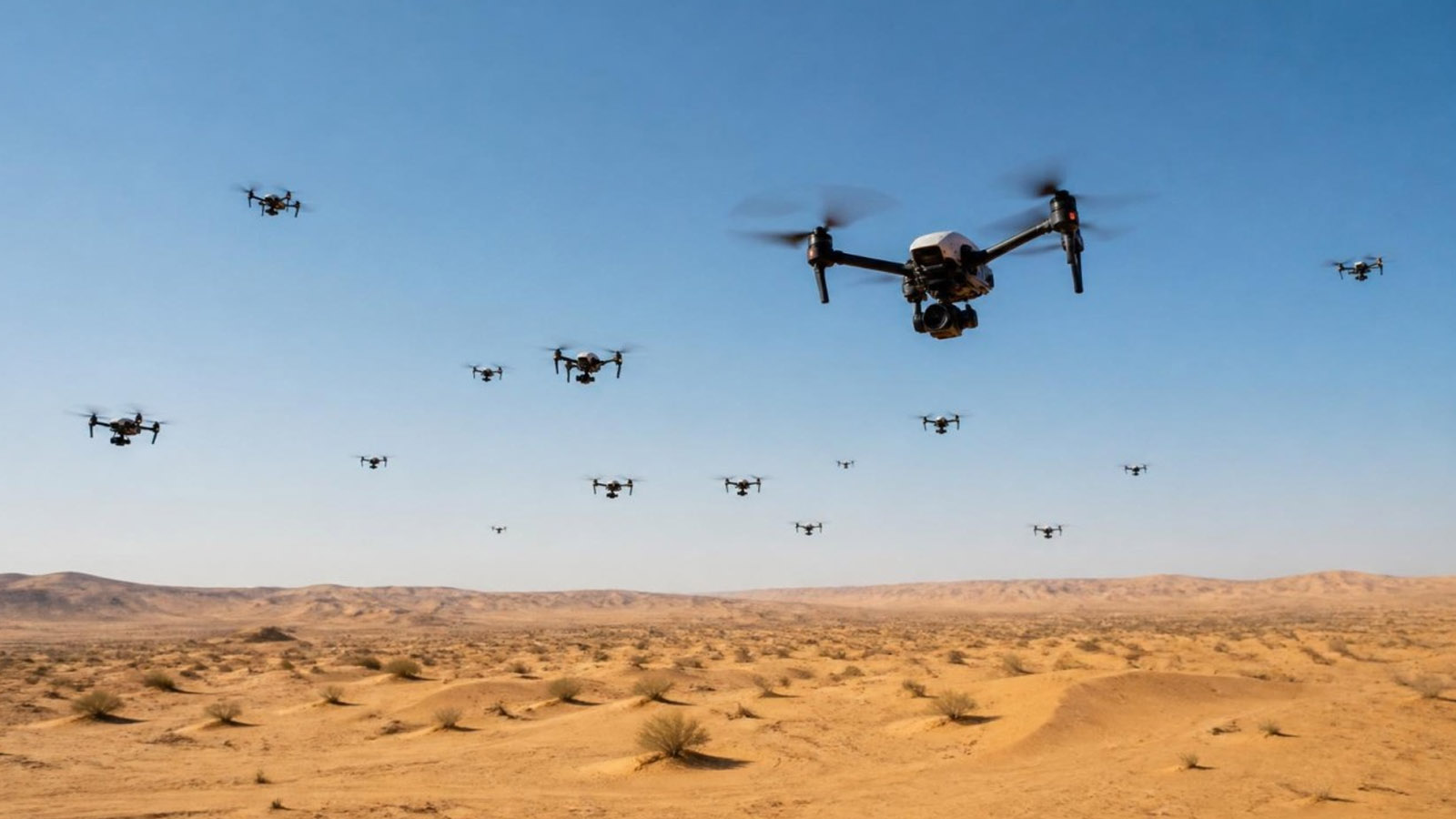
In 2014, I warned the Department of Homeland Security that commercial drones could bypass most of our post-9/11 security architecture. Two years later, drone incursions over U.S. and allied positions forced U.S. Central Command to create a task force to counter small, unmanned aircraft. Today, small drones are redefining modern war.
In 2015, I ran a tabletop exercise with Brian James, pilot of the Breitling Orbiter, asking whether a nuclear device could be lofted over the United States without attribution. We concluded it could. In 2023, China’s balloon flights over North America demonstrated the concept in real time. When Congress later asked why the threat had not been addressed, the only existing white paper citing the validated risks had been widely digested but not meaningfully acted upon.
In 2016, while flying combat missions in the Middle East, I watched a nation effectively run out of fresh water. It became clear that a country can begin to unravel in just days if its strategic water supply is targeted. I co-founded Genesis Systems to urgently develop water-from-air technologies at utility scale. Eight years later, even as our technology wins global acclaim and finds backing from multiple military service partners, water scarcity is outpacing our most dire models. In 2024, Nature estimated 4.4 billion people now live in water scarcity—half the world. Iran is now considering relocating a city of 10 million people—an unprecedented prospect in modern history. Day Zero now threatens more than a dozen major cities, including Los Angeles, Mexico City, Cape Town, and Las Vegas, to name a few.
In 2018–2019, I led a 360-member Joint Chiefs of Staff task force focused on U.S. critical infrastructure vulnerabilities. The conclusion was unambiguous: the threat is grave and largely unmitigated. Our enemies plan to exploit it. In my final briefing, Gen. Paul Selva, then Vice Chairman of the Joint Chiefs, invited me to ask him anything. I asked whether we understood that America was no longer truly sheltered by its nuclear umbrella. He answered, “Yes.” Our task force validated gray-zone threats that could directly cause the loss of up to 280 million U.S. citizens.
That deserves repeating: 280 million U.S. citizens… The President sought to sign an executive order (EO) to correct the problem—but ultimately, he elected to study it yet again. The EO is a relic on the road to hell paved with good intentions.
The former Vice Chairman’s candid admission should trouble every American. Our nuclear triad cannot deter attacks that come without attribution. Adversaries may already possess the ability to strike in ways that are effectively untraceable. A deterrent without a credible response is not a deterrent. Our adversaries now eat, pray, and maneuver in a “gray zone” that lies just below the threshold of war. They have mastered the art of undermining a predictable and static United States. When and where they will act is now fluid—a true multiplier when working to confound the security and stratagem of a superpower.
In 2019, I worked with other U.S. Air Force officers to assess the long-term viability of the Svalbard Global Seed Vault. Earth has already lost an estimated 60–80% of its biodiversity. Even our “backup” bunker is nested within a melting glacier, vulnerable to climate change and sabotage. After discussions with the Global Crop Trust, stakeholders agreed the world needs a lunar seed vault—an off-world repository for Earth’s living heritage. Geopolitics derailed the initial coalition, but the need has grown more urgent with time.
Across these examples, the pattern is similar: risks are identified or missed, then hope or uninformed belief is used to address disasters instead of decisive actions or strategies to mitigate them. Too often, planners are called in “when it gets bad.” We are America’s problem solvers, but we are weary of watching avoidable failures repeat while deep and predictable issues are admired, debated, and shelved—sometimes for generations.
Consider a mundane but telling case. Today, we can provide only about 5% of the theater airlift required in a high-end, contested war. There is a simple administrative change—one paragraph in a nonlegal policy—that could significantly improve this capability at nearly zero cost to taxpayers. Because it is proactive and disrupts the status quo, it is unlikely to be adopted. We will instead spend billions reacting after the shortfall is exposed in crisis. Troops in forward areas may not receive ammunition or even water. And we can be confident there will be congressional hearings after the fact. But who will be held accountable?
For some time, I accepted Dietrich Bonhoeffer’s stark conclusion that “stupidity is a more dangerous enemy of the good than malice,” and that “against stupidity we are defenseless.” Today, I still regard his warning as incisive, but I also believe persistent patience—and relentless clarity—can wear down even formidable barriers. Inside every human is a survival instinct. To function, instinct must eventually trigger honest internal dialogue.
Still, the cultural tide is going out. Carl Sagan, writing in the mid-1990s, foresaw an America where manufacturing moved offshore, technological power concentrated in the hands of a few, citizens lost the ability to question authority, and superstition replaced critical thinking. He warned that the media would trade substance for sound bites, and that ignorance would be celebrated.
Sagan’s concerns are fully manifest in every respect. A recent and refreshingly candid article in The New Yorker notes that after a century of rising IQ scores—the so-called Flynn Effect—data show a reversal beginning around 2006. Measures of problem-solving, abstraction, and fluid intelligence have declined. Standardized test scores, reading, and civic literacy are slipping. We use our brains less. The stigma attached to being uninformed is fading.
The article goes on to note that information today is often far removed from its source—boiled down, reinterpreted, and frequently distorted. Truth becomes a derivative. The same pattern is emerging in our management of the world’s genetic plant heritage. We make copies of copies. In doing so, plant vitality and vigor are lost. In sum, we are creating weak crops devoid of resilience. If confronted with something new, the specimens needed to breed stronger varieties are vanishing.
Like crops with no ability to resist the environment, artificial intelligence will make “easy thinking” easier. In the short term, economic output may rise. Over time, however, output quality is likely to degrade. If we outsource too much cognition, we risk losing the ability to think critically at all. From a sociological perspective, that is a survival-level risk.
We have already seen how small, ignored warnings often precede real-world crises—not in lifetimes, in decades. Clear-eyed analysis frequently provides an accurate model of what will come, but we too often prefer to ignore the data or turn away from things that seem “too hard.” Program leadership reportedly dismissed strange popping sounds in the Titan submersible’s composite hull—microscopic failures ticking toward implosion. The final pop ended five lives. And we ignore millions to billions of lives?
Likewise, before 9/11, the signals were there. Systemic biases and the belief that the United States was “too big to fail” dulled our response. History is unkind to societies that fail to understand their strategic vulnerabilities; they tend to succumb to them. As one historian reflecting on Gibbon’s Decline and Fall of the Roman Empire observed, Rome temporized to external threats and indulged in distractions and internal strife until the great fabric of the empire tore apart under its own weight.
In submarine warfare, a single sonar ping is a calculated risk—a whisper in the dark, a precise signal to a specific audience. In The Hunt for Red October, Captain Ramius (Sean Connery) orders: “One ping, Vasili. One ping only.” It is time for us to move beyond silent, anxious glances and begin pinging one another—clearly and deliberately—about what must be done to preserve the legacy of freedom obtained at a high cost.
In that spirit of action and preservation, Project Transcendence has been re-established to gather the world’s best minds to design and build a lunar seed vault—a durable off-world repository for Earth’s biodiversity, including threatened plants and coral. During the Syrian civil war, seed banks in Aleppo were destroyed. Had there been no backups, entire species of drought-resistant wheat would have vanished. Svalbard itself has already been breached by meltwater.
If humanity wants to be in the survivors’ club, we must first be intellectually honest.
We still have a window. We must act before events, operating through blind spots, close it.
We must think like survivors, not victims—calm, focused, deliberate, refusing to yield to a fate shaped by the inaction of others.
We must act. And by acting, we may yet preserve humanity and the rules-based order.
About the Author
Dr. David Stuckenberg is a U.S. water-industry leader and national security expert in the field of gray-zone and hybrid warfare. His career in defense and industry spans the White House and State Department to the Joint Chiefs of Staff (JCS) and the U.S. Air Force. He led a multi-year JCS task force on critical infrastructure vulnerabilities; his work is part of the Air University General Curtis LeMay Papers Collection. As a special operations pilot, Dr. Stuckenberg has flown more than 150 combat missions. He holds a B.S. in aerospace engineering, a master’s degree in public policy, and a Ph.D. in Strategic Security and Strategy Studies from King’s College London. He is also a graduate of Air Command and Staff College and serves as Program Director at Project Transcendence.
Disclaimer Information:
The views and opinions expressed in this newsletter are solely those of the individual contributors of the Council on Global Competition and Innovation, Inc. (“CGCI”) and are not the views of CGCI or its affiliates.
Certain information included herein has been sourced from third parties, including external organizations or entities mentioned in this publication. While such information is believed to be reliable, CGCI has not independently verified its accuracy or completeness and makes no representations or warranties regarding its reliability or suitability for any specific purpose.
This newsletter is provided for informational purposes only and does not constitute legal, financial, investment, or professional advice. Readers should consult their own advisors before making decisions based on the content herein. Any references to specific entities, securities, or digital assets are for illustrative purposes only and do not constitute endorsements or recommendations.
This content is not intended to solicit investment or participation in any financial products or services. Past performance mentioned, if any, is not indicative of future results. CGCI disclaims any liability for actions taken based on this information.
Charts and graphs are illustrative and should not be relied upon for decision-making purposes. Any projections, estimates, forecasts, targets, prospects, and/or opinions expressed in these materials are subject to change without notice and may differ or be contrary to opinions expressed by others. All content reflects information available as of the date of publication.
For further details, please refer to our Terms of Use policy at https://www.cgci.org/terms-of-use.