By Lance Bush, Space Advocate, Advisor, and CGCI, Council Member
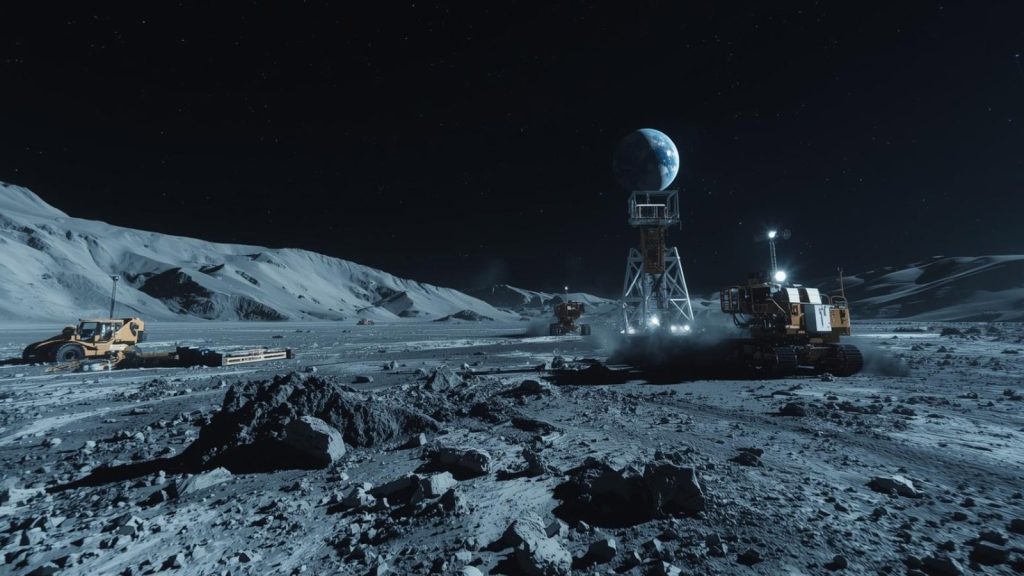
Recently, Bluefors—a Finnish company specializing in cryogenic cooling systems for quantum technology—signed a $300 million agreement to secure a supply of lunar Helium-3. Helium-3 is a rare, stable isotope with exceptional value for quantum research and promising potential as a fuel for clean nuclear fusion. While Helium-3 is extremely scarce on Earth, it is far more abundant on the Moon. Beginning in 2028 and running through 2037, this contract marks a historic shift: the delivery of a substance mined from the Moon to support advanced industries back on Earth.
Does this signal that the space energy market is here?
The answer is clear when companies like Bluefors—already a global leader in quantum cooling—are willing to commit such a significant investment. Their multi-year agreement reflects a surge of commercial confidence and signals broad recognition of the strategic value of space resources. This is far more than a technological milestone; it marks a pivotal moment in the global race to secure critical material for quantum computing and national security.
Quantum computing, advanced data centers, and the next generation of high-performance industries will require massive energy for cooling—and lunar Helium-3 could meet that need. Interlune, led by several key figures who previously held roles at Blue Origin, has identified Helium-3 as the first space resource truly worth mining. To put this into perspective, Helium-3’s estimated value—ranked as the sixth most valuable substance on earth—means its extraction could fundamentally shift global resource markets and innovation priorities. With the potential to enable fusion, Helium-3 is a linchpin for both commercial success and the future of American and allied competitiveness. Valued at roughly $20 million per kilogram and with lunar reserves estimated at $1.5 trillion, Helium-3 is no longer just a scientific curiosity. For U.S. industry and policy, leadership in mining and deploying space resources is imperative.
A New Era of Strategic Competition
America’s long-standing dominance in space technology is now under increasing pressure. China has made clear its ambitions to extract Helium-3 at industrial scale and link lunar mining to quantum and energy competitiveness. This is a direct challenge—not only to America’s technological advantage but to its broader security interests. Nations that control access to critical minerals and space-based energy will shape the global order for decades to come. For the U.S. and its allies, this means that space resource investment cannot be viewed as optional, but rather essential for economic and national security.
While space mining is not a new concept—it’s long been a subject of both science fiction and serious enterprise—no company has yet fully succeeded in commercial extraction. However, significant contracts and funding have been secured, in some cases with support from major earth-based mining companies that recognize the mutual benefits of advanced space technologies. These efforts have produced valuable breakthroughs: many firms in this sector have developed highly effective mining technologies, including autonomous equipment now improving efficiency and safety here on Earth.
Energy Security and the Imperative for Investment
The global space economy reached a record $613 billion in 2024 and is projected to grow to $2 trillion by 2040, driven in part by surging investment in energy technologies beyond Earth as the world seeks reliable, sustainable sources.”
Energy has always dictated the fate of nations. On Earth, our reliance on gas, coal, wind, and solar links our prosperity to finite resources and ongoing vulnerabilities, and history shows that wars have been fought over access to these energy sources. Yet our means of harvesting terrestrial energy remain relatively inefficient, especially when compared to what is possible beyond Earth. The universe’s energy potential is immense—hundreds of billions of stars per galaxy, trillions of galaxies, and cosmic phenomena such as colliding black holes that release more energy than all stars combined. Even dark energy and dark matter—barely understood—hold additional promise, underscoring how much untapped potential exists beyond our planet.
No less a visionary than Jeff Bezos launched Blue Origin with the goal of building infrastructure to harness energy from space. During a 2019 unveiling of the Blue Moon lander, Bezos articulated that energy, more than any other limiting factor, will drive the future economics and expansion of civilization into space. The logic is compelling: as terrestrial resources reach their limits, the economics of space-based energy rapidly become more attractive and essential. If the U.S. hopes to maintain a position of strength in this strategic domain, investment and policy focus must accelerate. Private pioneers like Bezos have laid foundation stones, but national strategy, robust partnerships, and government leadership are now vital.
Crucially, the race for these materials and energy sources is global. China and other competitors recognize the strategic stakes, aligning commercial goals with national defense imperatives. While this discussion has focused primarily on Helium-3, the Moon and beyond contain other valuable minerals, gems, and alternative energy forms in abundance. While debate continues over the legitimacy and practicality of harvesting space resources, the rapid achievement of milestones once thought impossible signals that a new era is truly within reach. Rapid technological advancement and strong economic and national security incentives are driving this market toward reality. The question now is not if—but who will lead. The next decade will determine whether America and its allies shape the rules and reap the rewards of this new space economy, or risk ceding strategic ground to global competitors.